

Timing Belts vs. Chain Drives: Advantages in Modern Drive Technology
Timing belt or chain? Learn why timing belts are the better choice in many modern applications
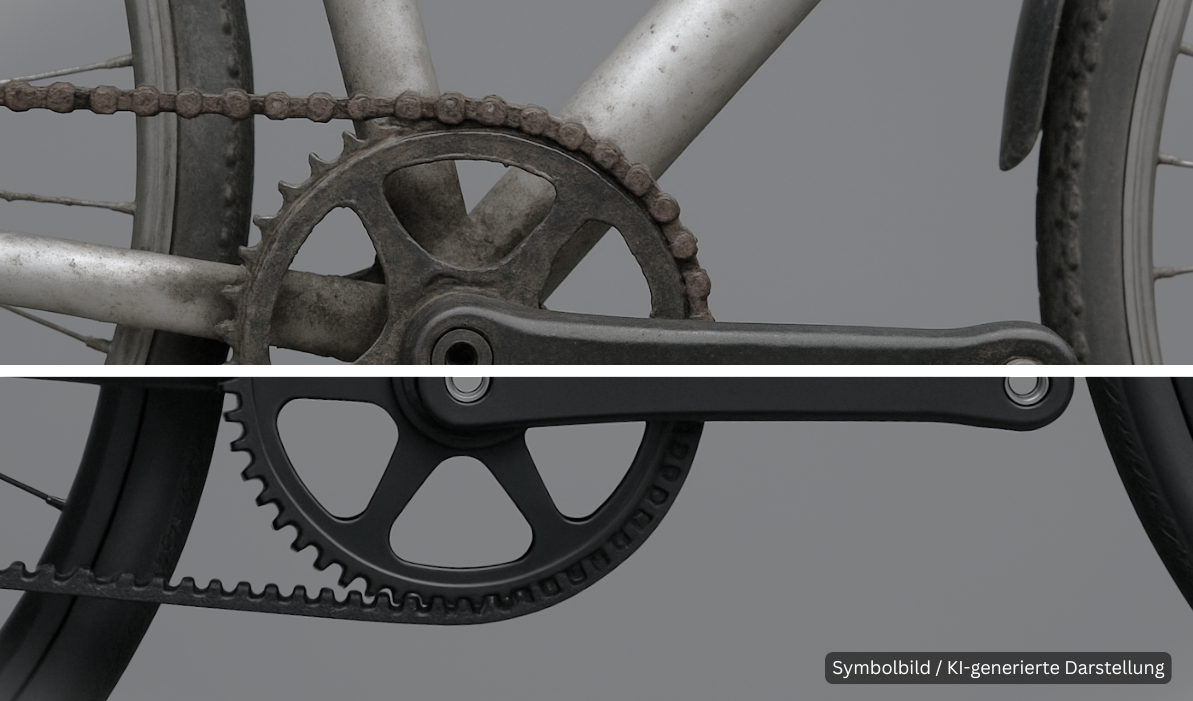
1. Introduction
Whether in industrial production, in conveyor technology or in the modern bicycle – the choice of the right drive system is a decisive factor for the efficiency and reliability of technical equipment. Two solutions are particularly in focus here: the classic chain drive and the increasingly prevalent, now considered best practice, timing belt drive.
Both transmit forces in a positive-locking manner, both have proven themselves in countless applications. But the technical requirements of today’s machines and vehicles have changed: longer service life, lower noise levels and less maintenance effort are in demand. This is precisely where timing belt drives show that they are ahead in many areas.
This article presents both systems, compares their characteristics and explains why timing belts are often the better choice in modern drive technology.
2. Fundamentals of Drive Technology
Positive-locking drives are designed so that torque is transmitted through intermeshing elements. In chain drives, metallic chain links perform this task by engaging with sprockets. Timing belts, on the other hand, consist of a tensile member – often made of steel, glass cord or aramid – and a jacket of polyurethane or chloroprene. The profile teeth of the belt engage precisely with the toothed pulleys and thus enable slip-free power transmission.
Terms such as line of action, pitch and gear ratio describe the geometry and operating principle of a system: the line of action refers to the position of the tension member within the belt, the pitch to the distance from the center of one tooth to the center of the next, and the gear ratio to the relationship between the rotational speeds of the driving and driven pulley. These fundamentals form the basis for the technical comparison of the two types of drive.
3. The Chain Drive: Tradition with Advantages and Disadvantages
The chain drive is a classic of drive technology. It consists of metallic links that are flexibly connected and run over sprockets. This system can transmit very high torques and is insensitive to short-term load peaks. It has proven itself over decades even in harsh environments, such as in agricultural machinery or in conveyor technology outdoors.
Its advantages lie in its robustness and comparatively simple design. However, the chain drive also has significant disadvantages: it requires regular lubrication to keep friction wear on the joints low. Without this care, the chain links tend to elongate, which has a negative effect on the accuracy of the entire drive. In addition, chain drives generate a noticeable level of noise at higher speeds, which can be disturbing in production environments. Added to this is the higher maintenance effort – retensioning, lubrication and occasional replacement are simply part of operating a chain.
Typical areas of application include motorcycles, construction machinery, agricultural machinery and industrial applications where dirt, dust or oil mist are present and the robustness of the chain justifies the increased maintenance effort.
4. The Timing Belt Drive: A Modern Alternative
The timing belt drive has developed over the past decades from a niche product into the preferred solution in many industries. It consists of a flexible, tensile member material provided with a toothing made of polyurethane or chloroprene. These teeth engage positively with the profiles of the toothed pulleys and transmit torque without slip.
Its strengths lie primarily in its smooth running and low noise emission. Since no lubricant is required, the timing belt operates cleanly and almost maintenance-free. In addition, its length remains constant over its entire service life, eliminating the need for retensioning. This significantly reduces operating costs.
Another advantage is the high positioning accuracy. In automation systems where precise motion sequences are required, the timing belt impresses with its even and smooth running. It also scores points in conveyor technology with its clean, oil- and grease-free operation. Even in the automotive industry, the timing belt is now standard: modern timing drives in engines rely exclusively on belts, after chains were often used in earlier decades. These belts operate more quietly and are lighter than the previously used chain solutions.
Thanks to its versatility and the continuous development of materials, the timing belt drive is a contemporary, future-proof alternative that surpasses chain drives in many applications.
5. Technical Comparison: Timing Belts vs. Chains
After presenting both systems, a direct comparison is worthwhile to clearly highlight the technical differences. Key criteria are considered that, in practice, determine the choice of the appropriate drive.
Power Transmission and Efficiency
Chain drives are able to transmit very high torques. However, joint wear and the necessary lubrication lead to a loss of performance over time. Timing belts, on the other hand, run slip-free in the toothed pulleys and, thanks to their precise toothing, achieve a very high efficiency that remains constant over long periods.
Noise Behavior
A striking difference is evident in operating noise. While chain drives generate a clearly audible running noise and transmit vibrations at high speeds, timing belts operate almost silently. This makes them the preferred solution in noise-sensitive production environments.
Maintenance and Operating Costs
Chains require regular lubrication and retensioning. These measures not only cause additional costs but also lead to downtimes. Timing belts, on the other hand, require no lubrication, maintain their tension for a long time and thus reduce maintenance effort to a minimum. Operating costs are significantly reduced.
Service Life and Wear
In chains, abrasion at the joints leads to elongation and ultimately to the replacement of the entire chain. Timing belts, thanks to their material concept, maintain a constant length over their entire service life and are extremely durable when used correctly. This means less downtime and predictable replacement intervals.
Operating Temperatures and Environmental Influences
Chains are sensitive to dust, dirt and moisture, as these factors affect lubrication and increase wear. Modern timing belt materials such as polyurethane, on the other hand, are resistant to typical environmental influences and are also suitable for cleanrooms or hygienically sensitive applications.
| Criterion | Timing Belt | Chain Drive |
|---|---|---|
| Power Transmission | Slip-free, high efficiency | High forces, but higher wear |
| Noise | Very quiet, low vibration | Loud, prone to vibration |
| Maintenance | Almost maintenance-free | Regular lubrication needed |
| Service Life | Long, constant length | Elongation due to joint wear |
| Environmental Influences | Insensitive, clean | Sensitive to dust/dirt |
6. Practical Examples
How do timing belt drives perform in practice? The following examples from different industries show which specific advantages arise in daily operation.
Packaging Machines
In modern packaging machines, timing belts are the preferred solution. They enable smooth, even running, which is crucial at high cycle rates. The absence of lubricants keeps the production environment clean, and long maintenance intervals ensure minimal downtime. Manufacturers report significantly reduced service costs and noticeably improved overall equipment effectiveness.
Conveyor Systems
Timing belts also show their advantages in conveyor technology. Conveyor belts driven by timing belts run quietly and without lubrication – a clear advantage in industries with high hygiene requirements such as the food or pharmaceutical sectors. Maintenance-free belts here mean fewer unplanned downtimes and less manpower needed for maintenance.
Bicycle Technology
A particularly vivid example comes from the bicycle industry. More and more city bikes and e‑bikes are now using timing belt drives. Riders appreciate the clean solution: no oil, no grease, no dirt on clothing. At the same time, the systems impress with a long service life and almost silent operation. Especially for urban use, where reliability and low maintenance are a priority, timing belt drives are clearly superior.
7. Future Trends and Innovations
Development in timing belt technology does not stand still. New material mixtures enable belts with even higher load capacity and improved service life. Special tooth profiles are also being developed to further reduce noise and increase efficiency.
In addition, digitalization is becoming increasingly important in this area as well. With the help of sensors, operating data can be recorded and evaluated so that maintenance intervals can be planned proactively (predictive maintenance). This avoids unplanned failures and optimizes system availability.
Another trend is the focus on sustainability: manufacturers are researching recyclable materials and resource-saving production processes to further improve the environmental balance. This makes the timing belt not only a technically but also an ecologically future-proof solution.
8. Conclusion and Recommendations
The comparison between timing belt and chain drive shows clearly: for many modern applications, the timing belt is the superior solution. It operates quietly, requires no lubrication and impresses with a long service life as well as minimal maintenance effort. These properties not only reduce operating costs but also increase the efficiency and reliability of systems.
For designers and purchasers, it is therefore worthwhile to consider the use of a timing belt system for new projects. Where once the robustness of the chain was decisive, today the precision and elegance of the belt convince.
Do you want to learn more about modern timing belt solutions or directly select the right product? Visit our online shop or contact our technical team for individual advice!