

The Digital Twin – How Virtual Replicas Make Real Timing Belts Smarter
The digital twin links real machines with virtual models and opens up new possibilities for industry and engineering.
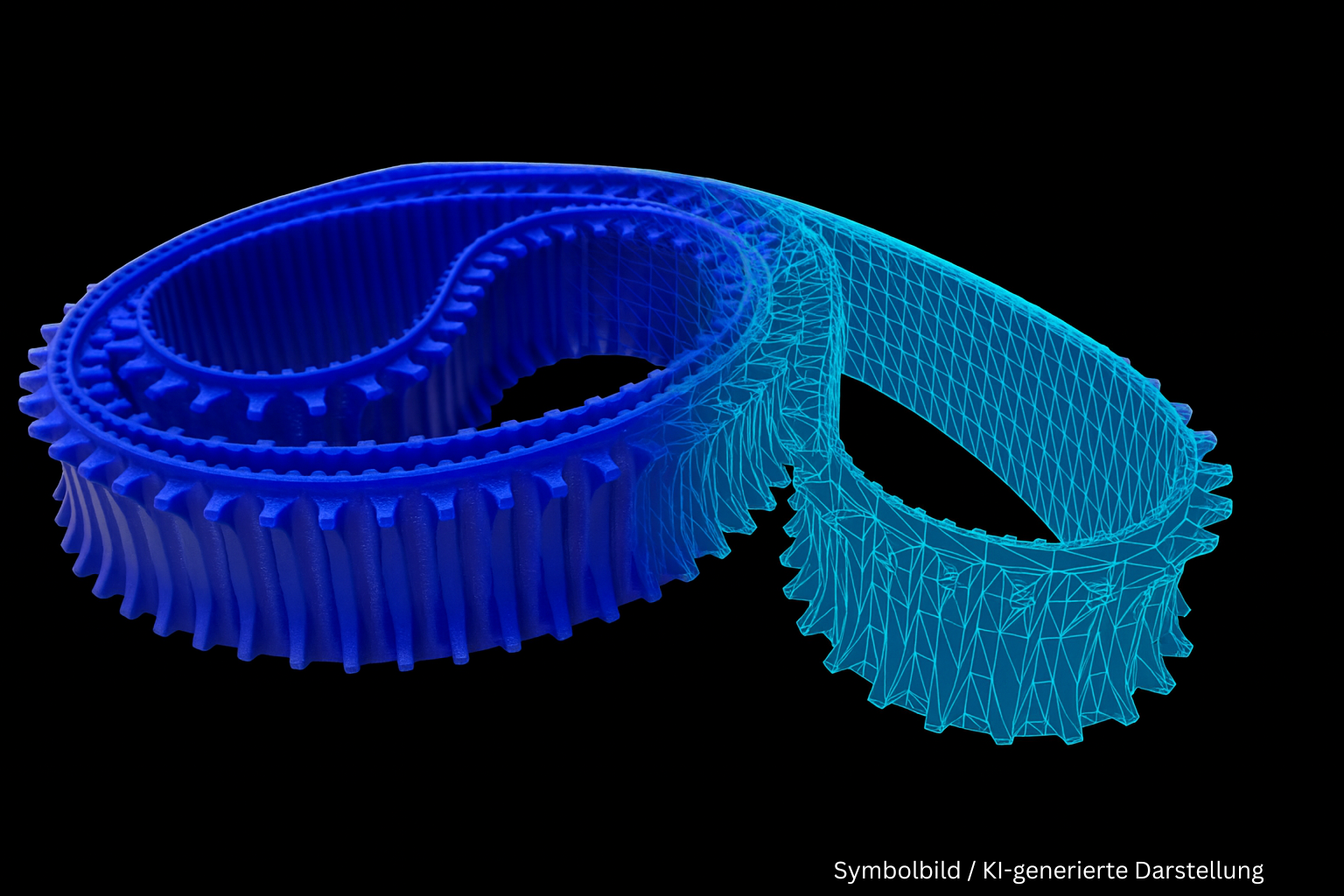
Digital twins are regarded as a key technology of Industry 4.0. But what exactly lies behind the term, and what benefits does it offer for mechanical power transmission?
This article shows the role digital twins play in timing belt technology in particular. The focus is not on abstract IT models, but on concrete issues related to development, design and operation.
Among other things, this article addresses the following questions:
- What distinguishes a digital twin from classic CAD or simulation models?
- How does a digital twin work from a technical perspective, and which data is required?
- What advantages arise for the design and operation of timing belt drives?
- Where are the practical limits of digital twins?
- What role do digital twins play in the context of Industry 4.0 and networked production systems?
The aim is to classify the digital twin as a technical tool in a comprehensible way and to present its benefits for modern timing belt technology in a factual and practical manner.
1. From the real drive to the digital representation
In mechanical engineering, technical systems have traditionally been designed using calculations, drawings and simulations. For many decades, these methods have formed the basis of engineering work. They make it possible to define geometries, estimate forces and design components for defined load cases. In practice, however, they usually represent only selected operating conditions. Scenarios are often simplified or standardized.
With increasing demands for efficiency, dynamics and system availability, this approach is no longer sufficient in many cases today. Machines are used more flexibly, motion profiles change and cycle rates increase. At the same time, the demand is growing to design components as resource-efficiently as possible while remaining reliable. Against this background, a concept is gaining importance that goes beyond classical design: the digital twin.
A digital twin is a virtual representation of a real technical system. It describes its properties, states and functional behavior as realistically as possible and ideally accompanies the physical object throughout its entire life cycle. Unlike a static model, a digital twin can be further developed and updated when operating conditions change or new insights from operation become available.
This approach is of particular interest for mechanical drive components such as timing belts. Timing belts are regarded as precise, low-maintenance and efficient drive elements. However, their behavior in real operation is influenced by a large number of factors. These include, among others, pretension, transmitted forces, temperatures, accelerations and the specific installation situation within the overall system. Manufacturing tolerances, wear and aging also play a role.
These factors do not act in isolation, but influence each other. Changes in one parameter can affect running accuracy, noise behavior or service life. Classical design methods reach their limits here, as they can only represent such interactions to a limited extent.
This is precisely where the digital twin comes into play. It complements the real timing belt drive with a digital counterpart that combines calculation, simulation and even real operating data. The goal is not the complete virtualization of the system, but a deeper technical understanding. The digital twin makes relationships visible that are often difficult to identify in real operation and thus creates an additional planning basis for design and operation.
2. What is a digital twin – and what is it not?
The term “digital twin” is frequently used, but not always clearly defined. This makes it all the more important to clearly distinguish it from other digital tools that have long been established in mechanical engineering.
A CAD model or a one-time simulation does not yet constitute a digital twin. Such models are static and describe a defined state. They are usually created during the development phase and are not updated later. Their purpose lies in construction, visualization or theoretical design.
A digital twin goes beyond this. It describes a real object or system in digital form and is related to its physical counterpart. Depending on the stage of development and data connectivity, different forms can be distinguished.
- Digital model:
A purely virtual representation without reference to real operation. It forms the basis of many design and simulation tasks. - Digital shadow:
Real operating data flows into a digital model, for example for condition monitoring or analysis. The direction of information is one-way. - Digital twin:
The digital model is in a bidirectional relationship with the real system. Insights from the digital representation can be used to specifically influence or optimize operation.
Only this last stage justifies the term “digital twin”. It requires that the digital model is not merely observed, but actively integrated into decision-making processes.
When this concept is applied to timing belts, the difference becomes clear. Classical design programs provide characteristic values such as permissible tensile forces, recommended pretensions or safety factors. This information is necessary, but it largely considers the timing belt in isolation.
The digital twin, by contrast, represents the timing belt as part of a complete drive system. It takes into account interactions with pulleys, shafts, bearings and driven masses as well as real load profiles and motion sequences. This creates an overall picture that goes beyond the consideration of individual components.
3. How does a digital twin work technically?
From a technical perspective, the digital twin is not a single tool, but an interaction of several methods and disciplines. At its core are physical and mathematical models that describe the behavior of a system. In the case of timing belt drives, these include, among others, models for tensile forces, elasticity, damping, tooth load capacity and dynamic effects during acceleration and deceleration.
These models are implemented in simulation environments. Depending on the question at hand, analytical calculations, multibody simulations or finite element methods are used. The required level of detail depends strongly on the application. Not every question requires a high-resolution model. Often, targeted simplification is useful in order to clearly highlight relevant effects.
Real operating data plays a central role. Sensors can provide information on speeds, temperatures, operating times or vibrations. This data is used to update the digital model and adapt it to the actual condition of the system. The digital twin thus develops in parallel with the real drive and represents it as realistically as possible.
This results in concrete advantages, especially for timing belt drives. The interaction of different load components can be described on the basis of real data. Dynamic effects can be evaluated more effectively, particularly in the case of frequent load changes or highly dynamic motions. Wear processes can also be assessed in a more differentiated way than is possible with purely static approaches.
At the same time, it becomes clear that the digital twin is not a self-running solution. Its informative value depends directly on the quality of the underlying models and data. Engineering expertise therefore remains indispensable. The digital twin does not replace experience, but extends it with an additional, data-based perspective.
4. Digital twins in mechanical engineering – focus on timing belts
In mechanical engineering, digital twins are primarily used wherever technical systems must operate reliably under variable conditions. These include machine tools, automation systems, packaging machines and linear positioning systems. In many of these applications, timing belts perform central functions, as they can transmit motion precisely, synchronously and without slip.
Here, the digital twin opens up the possibility of not viewing timing belts in isolation as individual components, but as functional elements of a complex drive system. Geometric data, material properties, mass distributions and real motion profiles are brought together in a single model. This makes it possible to analyze interactions that are often only taken into account in simplified form in classical design methods.
A typical application example is linear drives with high requirements for positioning accuracy and dynamics. High accelerations, frequent changes of direction and tight tolerances interact here. The digital twin can show how parameters such as pretension, belt length or profile selection affect the dynamic behavior of the system. The interaction with guides, drive motors and control technology can also be evaluated more effectively.
In addition, the digital twin is playing an increasingly important role in conveying and handling technology. Timing belts often perform both drive and transport functions here. Different load conditions, variable speeds and long travel distances place particular demands on material selection and design. Digital models help to realistically map these requirements and optimize them for specific applications.
The digital twin thus supports a systemic view of timing belt technology. It creates a link between constructive design and real-world application and makes it possible to better substantiate technical decisions.
5. Advantages of digital twins for timing belt drives
The use of digital twins offers several technical advantages for timing belt drives that affect both the development phase and subsequent operation.
In classical design methods, load assumptions are often chosen conservatively. Safety factors are intended to compensate for uncertainties, but not infrequently lead to overdimensioning. The digital twin makes it possible to capture real loads in a differentiated way and incorporate them into the design. As a result, belt width, profile and tensile member can be selected more precisely.
Another advantage lies in the analysis of dynamic effects. Timing belt drives are exposed to highly dynamic loads in many applications. Accelerations, decelerations and load changes can lead to vibrations or uneven force distribution. Digital twins help to identify such effects at an early stage and take them into account constructively.
Digital twins also offer added value during ongoing operation. By linking them with operating data, changes in condition can be tracked and evaluated. Deviations from expected behavior can indicate altered loads or the onset of wear. This creates the basis for condition-based maintenance concepts.
Last but not least, the digital twin facilitates communication between different specialist departments. Development, design, commissioning and operation all access a shared model. Technical decisions become more transparent and easier to understand, as they are based on a common data foundation.
6. Limits and challenges of digital twins
Despite their advantages, digital twins are not a universally applicable tool. One of the greatest challenges lies in model development. A digital twin is only as meaningful as the underlying models. Incomplete or overly simplified assumptions can lead to incorrect conclusions.
Especially for mechanical components such as timing belts, not every relevant variable can be measured directly. Although sensors can provide information on speeds, temperatures or operating times, many mechanical effects must be modeled or determined indirectly. Engineering experience therefore remains indispensable.
Another aspect is the economic effort involved. The creation and maintenance of a digital twin require time, expertise and suitable tools. Not every application justifies this effort. In many cases, a simplified model that is specifically tailored to certain questions is sufficient.
In addition, integration into existing processes is required. Digital twins only unfold their benefits if they are meaningfully embedded in development and operating workflows. Isolated individual solutions often fall short of their potential.
These limits make it clear that the digital twin is not a replacement for classical design methods, but a supplement. When used correctly, it expands the understanding of technical systems. When used incorrectly, it can lead to a false sense of security.
7. Digital twin and Industry 4.0
The digital twin is closely linked to the concept of Industry 4.0. The aim of this development is to network industrial processes more closely, make them more transparent and enable them to respond more flexibly to changing requirements. Digital twins perform a connecting function between physical technology, digital modeling and data-based analysis.
While digital models were previously used mainly during the development phase, their application is now increasingly shifting toward operation. Machines, systems and individual components continuously provide data that flows into digital representations. This data is not only used for documentation purposes, but also to assess conditions, identify deviations and optimize processes in a targeted manner.
For timing belt drives, this development means a changed role within the overall system. They are no longer viewed exclusively as mechanical standard components, but as functional elements whose behavior influences productivity, quality and availability. The digital twin makes it possible to better understand these relationships and to optimize timing belts in a targeted way.
In networked production environments, for example, changes in load profiles can be identified at an early stage. Increasing cycle rates, new motion sequences or changing product weights have a direct impact on the load on timing belts. The digital twin makes it possible to evaluate such changes virtually before they lead to increased wear or unplanned downtime.
At the same time, it becomes apparent that the benefits of digital twins in the sense of Industry 4.0 depend heavily on their integration. Only when digital models, control systems and organizational processes interact meaningfully does real added value emerge. For timing belt technology, this means that the digital twin does not act in isolation, but as part of a networked overall system.
8. Outlook: From the digital twin to self-optimizing drive technology
The development of digital twins is far from complete. At present, analysis and decision support are the primary focus. For the future, however, more advanced applications are emerging in which digital twins are increasingly integrated actively into optimization processes.
In combination with data analysis methods, pattern recognition or artificial intelligence, digital twins can automatically detect deviations from normal operation. For timing belt drives, this opens up prospects for adaptive maintenance and operating strategies. Instead of fixed maintenance intervals, measures could be more strongly aligned with the actual state of load and wear.
New opportunities are also emerging in development. Digital twins make it possible to systematically compare variants and to adapt them in a targeted manner to different application profiles. Instead of standardized components, application-specific solutions are increasingly coming into focus, taking mechanical requirements, dynamics and environmental conditions equally into account.
In the long term, it is conceivable that digital twins will not only analyze, but also derive recommendations for action. Changes to motion profiles, pretensions or operating parameters could be proposed on the basis of digital models. However, this requires a high level of model quality and technical understanding.
The digital twin does not replace engineering work. Its strength lies in making complex relationships visible and supporting technical decisions on a data-based foundation. The better the underlying models and assumptions, the greater its benefit for drive technology.
9. Conclusion: The digital twin as a tool for modern timing belt technology
The digital twin has developed from an abstract future concept into a practical tool in mechanical engineering. It makes it possible not only to design technical systems, but also to analyze and better understand their behavior over the entire life cycle. This approach opens up new possibilities, particularly for timing belt drives.
Timing belts are exposed to high dynamic and thermal loads in many applications. Their operating behavior is determined by numerous influencing factors that can only be considered jointly to a limited extent using classical methods. The digital twin makes it possible to combine calculation, simulation and real operating data within a single model.
For development and design, this results in a more precise evaluation of real load cases and a more robust basis for decision-making. In operation, the digital twin supports condition assessment and forms the basis for adapted maintenance activities and optimization measures. At the same time, it remains clear that its benefit is directly linked to the quality of the underlying models and data.
The digital twin does not replace engineering experience, but complements it. When used correctly, it helps to make timing belt drives more efficient, more durable and easier to control. This makes it an important building block of modern, networked drive technology.